Thursday, 17 December 2015

Worthy cause the 4 eye grabbing Audemars piguet guide

          4 Affordable Audemars buying guide watches

Audemars Piguet Royal Oak Offshore Diver

If the Royal Oak is an icon, its big brother, the Royal Oak Offshore (“ROO” to those in the know) is a modern sensation. Offshores are Royal Oaks turned up to 11. Today the ROO seems like a natural development, but when the concept was first proposed, it shocked even AP management. Fortunately, the Offshore received a green light, and a new Royal Oak era was born.
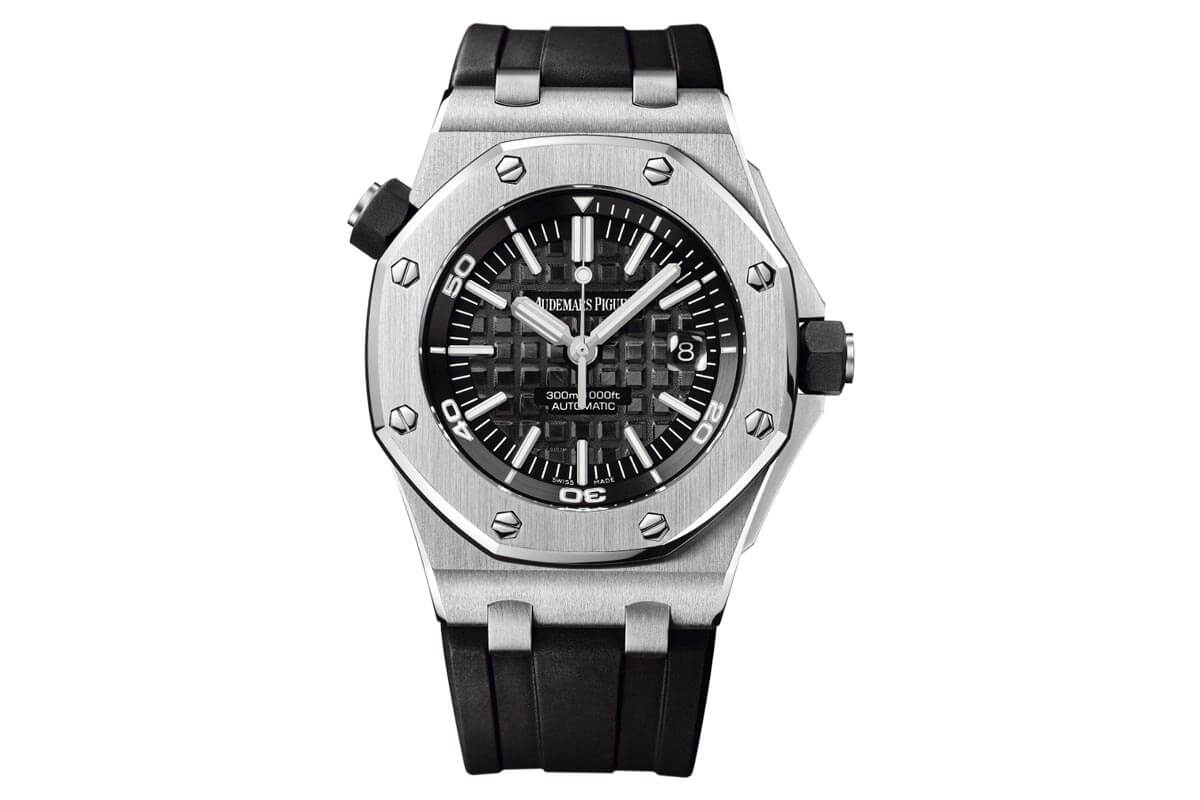
Audemars Piguet Royal Oak Diver 15703st
Our featured watch is the Royal Oak Offshore Diver, reference 15703ST, and it is among the most popular members of the Offshore family. It features the “rubber-clad” accents often found on Offshore models, The case measures 42 mm x 13.9 mm and it offers 300 meter water resistance. The crown at 10 o’clock turns the internal bezel with the typical countdown markings. The Mega Tapisserie dial is a larger version of that found on the Royal Oak shown above, and the broad hands offer excellent legibility. The in-house caliber 3120 provides the power.
The Royal Oak Offshore Diver 15703ST on a rubber strap retails for $19,000

Audemars Piguet Millenary 4101

The Millenary 4101 is Audemars Piguet’s modern spin on the classic dress watch, and like the Royal Oak Offshore, the size and shape of the case instantly set this watch apart. Our featured model, reference 15350ST, measures 47 mm from 9 to 3.
The case may be the first thing that catches the eye, but the movement is the star of the show. Unlike many shaped watches, the Millenary’s in-house caliber 4101 movement fits the case and follows its form perfectly. Though at first glance this may look like a so-called skeleton watch, in fact it is not – no material has been removed from any component to enhance the view. The small dials leave plenty of room to enjoy the traditionally-finished movement beneath, and the sapphire display back offers visual enjoyment from that side as well.
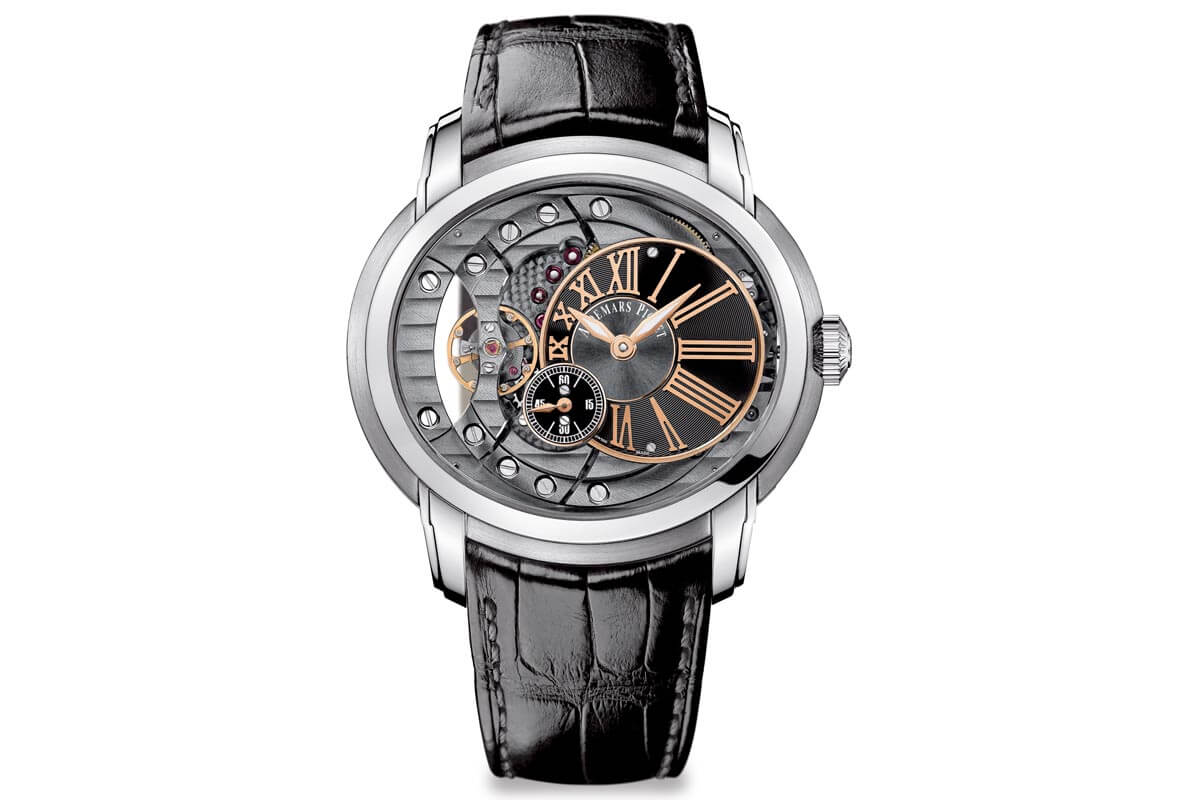
Audemars Piguet Millenary ref.4101

The movement has been designed to create a deep, three-dimensional effect. The construction exposes the freesprung balance at 3 o’clock, and AP has thoughtfully inverted the escapement to improve the view from the dial side. The manufacture caliber 4101 features a solid 22k gold winding rotor spinning on ceramic bearings. Each part of the movement is decorated by hand. These time-consuming operations by highly trained specialists contribute significantly to the cost of the watch. The mainplate wears horizontal Côtes de Genève on the front and perlage, or circular graining, on the back. The bevels and countersinks are polished.
The Millenary 4101 in stainless steel on strap lists for $24,500

Audemars Piguet Royal Oak Offshore Chronograph – 42 mm

This year Audemars Piguet introduced six new Royal Oak Offshore models, and this is one of the most popular. It’s the ROO Chronograph in a 42 mm x 14.21 mm case with the slate gray “elephant” dial on a gray hand-stitched hornback alligator strap.
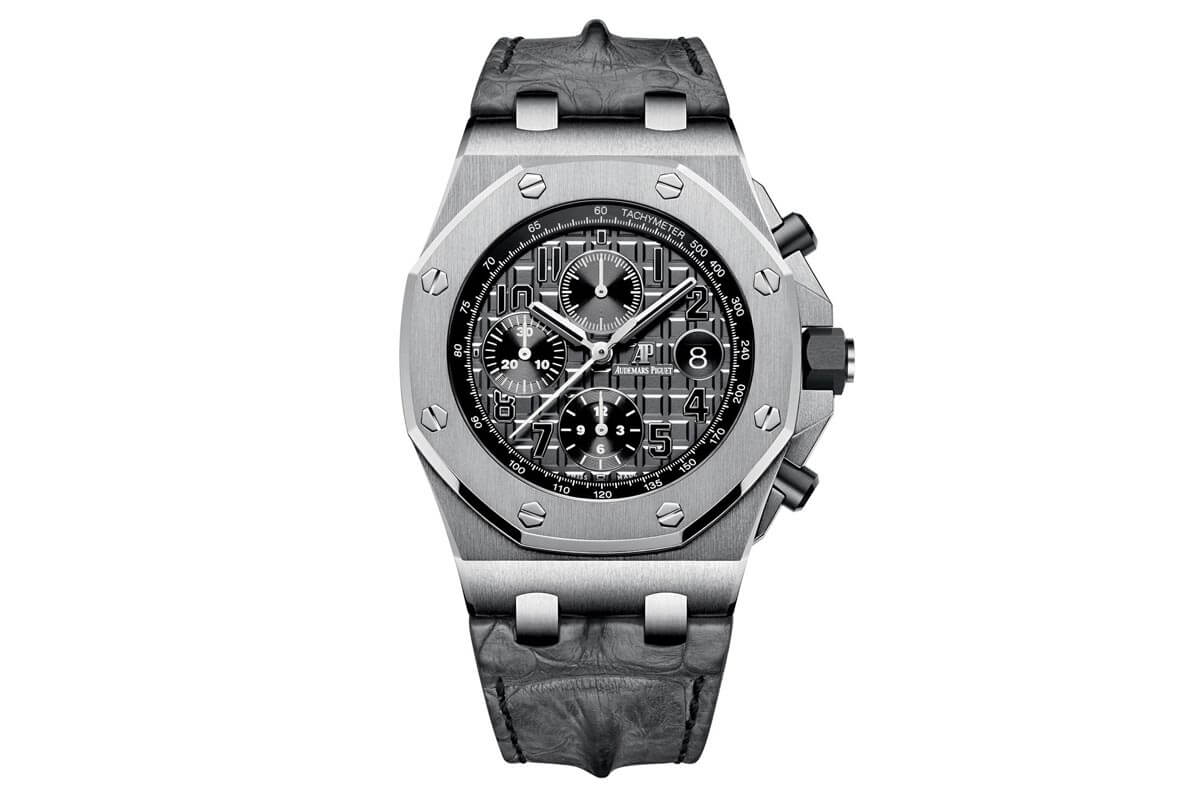
Audemars Piguet Royal Oak Offshore 26470
The new collection, which bears reference 26470, incorporates many updates. Rubber accents on the pushers and crown have been upgraded with black ceramic pieces. The new Mega Tapisserie dials have been well received, and the snailed subdials add even more texture. Broader, faceted hour and minute hands improve legibility.
The big surprise is found on the other side of the case: newly added sapphire display backs provide a view of the caliber 3126 chronograph movement with its solid 22k gold winding rotor. This movement features a cam-switching chronograph mechanism and stop-seconds for precise time setting.
The stainless steel Royal Oak Offshore Chronograph retails for $26,000

Audemars Piguet Royal Oak Offshore Chronograph – 44 mm

If you seek something a bit bolder than the 42 mm Royal Oak Offshore Chronograph shown above, consider its big brother in a 44 mm x 14.13 mm case. This model retains the familiar black bezel, fashioned from highly scratch-resistant ceramic. Large rectangular pushers replace the smaller round pieces found on the 42 mm models. Like the smaller sibling, this model features the Mega Tapisserie dial, here complimented by white gold hands and hour markers. The broad tachymeter at the outer edge of the dial lets you calculate speed over a known distance.
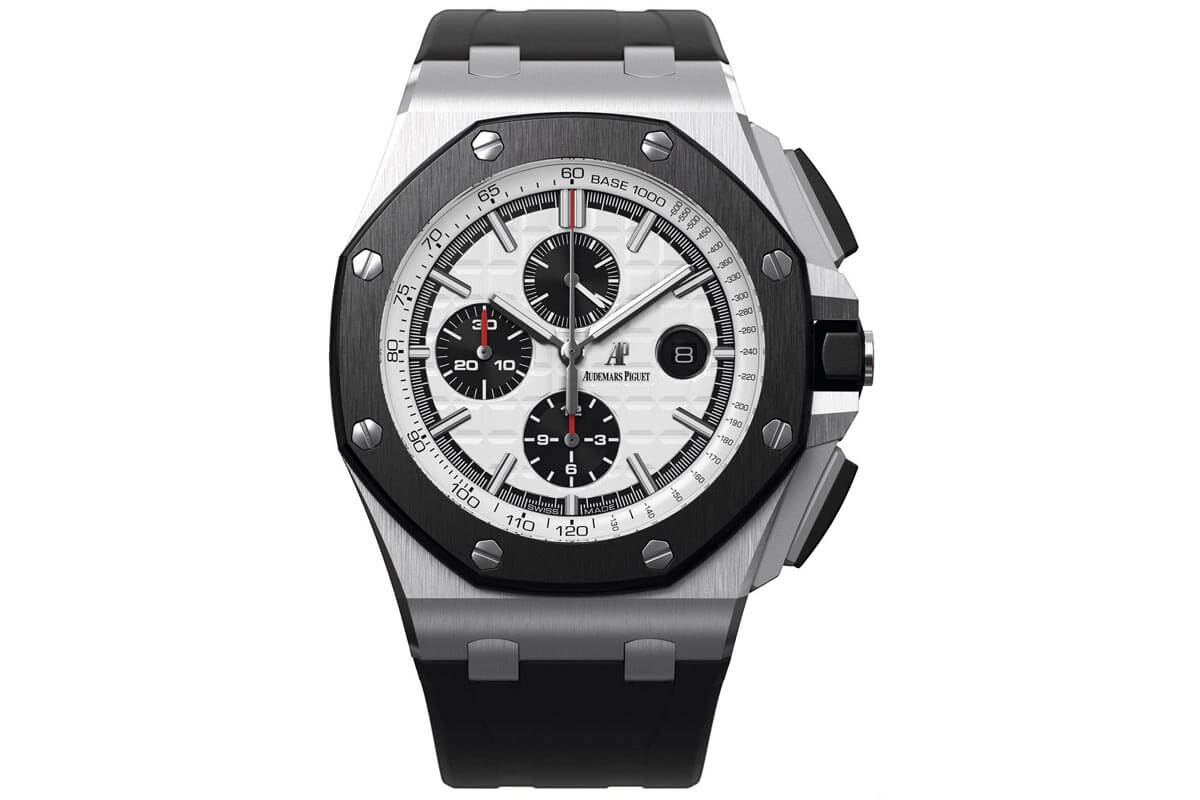
Audemars Piguet Royal Oak Offshore 26400
Behind the dial lies the caliber 3126 automatic winding chronograph movement with 365 components. The movement runs at 21,600 vph in 59 jewels. The dial registers include continuous seconds at 12 o’clock., a 30-minute counter at 9 o’clock, and a 12-hour counter at 6 o’clock.
The 44mm Royal Oak Offshore Chronograph in steel and ceramic on rubber strap, reference 26400, lists at $33,400
This article was first thankful by WatchTime, updated and republished on Monochrome-Watches with authorization. its  noted likewise and  thankful for  such a aqquired article also

Wednesday, 16 December 2015

The Rolex Watch Guide for beginners

                            Rolex  for beginners for  all

                                                   
Rolex has long been known as a horological status symbol. From the small business owner to the billionaire hip hop mogul, Rolex is arguably the largest and most prominent luxury watch company in the world.
From the basic stainless steel models under $10,000 to the binged out diamond bezels that fetch over $50,000, the fact is that Rolex has managed to acquire and maintain one of the most diverse client bases the world has ever seen. It consistently ranks high on lists of the top global brands and is influential the world over.
 

The History of Rolex

When two men married into the same family decided to start the company, it was originally named Wilsorf and Davis after the founders Hans Wilsorf and his brother-in-law Alfred Davis.
Initially intended to just be an importer of Aeigler’s Swiss watch movements to England, the company which would eventually become Rolex SA, was registered in London, England in 1905.
Wilsorf and Davis began to import the Swiss movements and place them in watches made by Dennison and others that they proceeded to sell to jewellers who put the name W&D on the inside of the case back and allowed the independent jewellers to place their own names on the dials.
It wasn’t until 1908 that Wilsorf registered the trademark “Rolex” and opened an office in La Chaux-de-Fonds, Switzerland. The name Rolex is often discussed, but widely believed by horologists to be a made up name that was used because it was onomatopoeic and easily pronounced in any language or accent. It reminded Wilsorf of the winding sounds of the watch and it is believed that these reasons are why the name Rolex was chosen to eventually become the name of their brand. It also helped of course, that the name was short enough to fit on the face of a watch and symmetrical.
By 1914, Wilsorf and Davis’ watches were so well established and known that the Kew Observatory awarded Rolex with a Class A precision certificate that was normally only awarded to marine chronometers. In 1919, Wilsorf left England due to the wartime taxation levied against luxury imports in addition to the exportation duties on silver and gold. With costs increasing, he moved the company to Geneva, Switzerland where he renamed it the Rolex Watch Company. Over the next few decades it would be changed again to Monres Rolex, SA and finally to Rolex, SA as it’s known today.
Wilsdorf quickly became well known as a charitable man and positioned himself as quite the contributor when he began replacing the Rolex watches of Britain’s soldiers who were captured as prisoners of war during World War II. When the POWs were captured and sent to camps the Rolex watches they had began purchasing were seized and confiscated by the Nazis. Many pilots had began to wear Rolex watches by the beginning of the 1940s as the quality superseded that of the generic watches they were issued by the military. In fact, one of the most well documented uses of a Rolex was when the watch was used to time the highly publicized Great Escape.
It was that one, of the 3000+ watches awarded to Royal Air Force pilots that was sent when a letter was received by Hans Wilsorf, written by a POW named Corporal Clive James Nutting.
Nutting had written to Rolex the same as many other servicemen, knowing that his precious watch would be replaced free of charge until the war was over. The watch, a stainless steel Rolex Oyster 3525 Chronograph was mailed to Nutting directly from Wilsorf and delivered to Stalag Looft II on July 10, 1943 with a note informing Nutting he “should not even think” about paying for the timepiece before the end of the war. What Wilsorf didn’t know at the time was the watch was specifically ordered for the purpose of orchestrating the Great Escape.
Far more expensive than the usual Speed King model ordered by airmen, Nutting used the chronograph to time the patrols of the prison guards as well as the 76 escapees through the tunnel on March 24, 1944. Eventually, after the war, Nutting did receive a bill for the watch for a grand total of just £15. In May, 2007, the watch was sold at auction for £66,000. Then, in November 2013, the Rolex Speed King owned by Flight Lieutenant Gerald Imeson during the Great Escape sold at auction for £60,000.
In 1944, one year before the war ended, Wilsorf wife tragically died. Wilsorf was very concerned that due to the massive growth of his company and with the United States showing interest due to his charity towards the captured servicemen, that his hard-earned money would simply go into the pockets of already wealthy investors should the company ever go public. To prevent such a thing from occurring, he established the Hans Wilsorf Foundation and left all of his shares to the charity to ensure that at least a portion the company’s income would go to charitable initiatives. To this very day Rolex is privately owned and it’s ownership lays in trust with the Hans Wilsorf Foundation. Despite its size, Rolex does not trade publicly on any stock market.
Today, Rolex is one of the world’s most powerful companies and the largest luxury watch brand in the world. They produce an average of 2,000 watches each day and maintain record revenues of upwards of $7 billion each year.
 
I hope you enjoyed this as much as I did thumbs up to all

Friday, 11 December 2015

selling a rolex

                          How to sell a  Rolex watch


If you our wondering how to sell a Rolex watch for the highest possible cash offer, Diamond Estate Jewelry Buyers can help. We are widely recognized as one of the best places in the country to sell vintage and limited-edition Rolex watches.
Thanks to our exclusive network of private Rolex buyers and collectors, we are able to regularly pay our clients not only more cash than any other watch buyer, but also more than they would have obtained by selling their Rolex through an online watch auction.
Because Rolex watches are made with such precision and with superior high-grade materials, they can yield their owners a substantial cash offer from luxury watch buyers. You can rely on Diamond Estate to freely share with you all of our expert knowledge, so that you can make the best educated decision about how to sell your Rolex watch.
In this article, our Rolex buyers will cover some common questions that clients have when planning to sell a used Rolex watch to Diamond Estate Jewelry Buyers.
1) Can I sell my Rolex watch for a good price if it contains non-Rolex parts?
Rolex buyers place a much higher value on a Rolex watch that has all of its original Rolex parts. It’s important that all Rolex owners ensure that authentic Rolex replacement parts are used when having their Rolex watch serviced, because non-Rolex parts will significantly lower the timepiece’s value. That being said, depending on what has been replaced, you may be able to get a good price when selling your used Rolex.
The best thing to do is to take advantage of Diamond Estate Jewelry Buyer’s free verbal Rolex appraisal to discover how much your timepiece is worth to our Rolex buyers.
2) Does supporting sales material increase the offer when selling a used Rolex watch?
California Rolex Buyers Absolutely. As you may know, there is probably no timepiece more often copied than a Rolex. There a literally hundreds of thousands of counterfeit Rolex watches in circulation. This can make it more difficult to sell a used Rolex watch without the original box and papers.
While a professional Rolex buyer can authenticate your Rolex watch without such items, they may find it more difficult to resell your watch to another customer. So, to get the best possible price when selling your Rolex, do include all and any original sales materials than came with your purchase.
3) Should I refurbish the dial before selling my used Rolex watch?
The answer is no. You probably have seen TV shows where a person selling a valuable vintage or antique item is told they never should have refurbished their item because collectors prefer the original untouched finish, regardless of its state. The same goes for Rolex watches. Even if the dial on your used Rolex does not look like new, you do not want to have it refurbished.
4) Does the state of the band affect the price when selling a Rolex?
Yes it does. Selling a used Rolex with a tight (like new) original band will bring you a higher cash offer than if the band is loose and older looking.
5) Can I sell a used Rolex watch even if it is not working?
Yes, you can. This may be surprising but you can often sell a Rolex watch that is not working for a price that is not far below the price of a used Rolex in working condition. The reason for this is that professional Rolex buyers can ordinarily have a Rolex that is not working repaired for a reasonable price.
6) Will I get close to the retail price when selling my Rolex?
Auction a Rolex While Rolex watches do hold their value well, you should not expect to receive a cash offer close to the retail price. You need to keep in mind that the jeweler who sold you your Rolex needs to make a substantial profit to stay in business. Just as when a car driven off a lot immediately depreciates in value some 20-30%, so does a new Rolex watch immediately depreciate in value once it has been bought (the exact percentage of depreciation will vary).
In addition, the Rolex buyer who purchases your used Rolex needs to make a profit too, so that that he or she can stay in business. Therefore, while you can expect a substantial cash offer for a used Rolex,  the amount will ordinarily not be close to the retail price–the exception being for certain vintage, limited-edition, and antique Rolex models which are hard to find and in high demand.
7) How safe is it to sell my Rolex watch online?
Selling a Rolex online to Diamond Estate Jewelry Buyers is highly secure and involves no risk whatsoever. We provide you with free FedEx Overnight shipping and your Rolex watch will be insured to its maximum value by G4S International Logistics, the world’s largest security services provider.
If you decline our final cash offer for any reason, we will be happy to ship your Rolex back to you at our expense. For more information about selling a used Rolex watch online to our Rolex buyers, please click on the following link: Sell My Rolex From Home.
If you decide that you would like to try to sell your Rolex online at eBay, there are a few things you can do to protect yourself: a) Sell your Rolex watch only to a buyer who lives in the United States. b) Take a photo of your Rolex that shows the serial number to help prevent return fraud. c) Don’t use a PayPal account that is linked to a bank account with a large balance.
8) How can I tell if my used Rolex watch is fake?
Used Rolex Buyers It’s always upsetting to discover that you’ve unwittingly purchased a fake Rolex watch. But due to the prevalence of fake Rolex watches, it is an unhappy situation that can and does happen. Here are some times when you don’t want to try to sell your Rolex watch because it unfortunately is a fake one:
  • Don’t try to sell a used Rolex if there is rubber to be found anywhere on the band or case. It’s fake.
  • Don’t try to sell a Rolex watch if it has a skeleton dial (a dial that displays the moving parts of the watch). It’s fake.
  • Don’t try to sell your Rolex if it says that it was made in China. It’s fake.
  • Don’t try to sell a used Rolex watch if it has a see-through glass case back. It’s fake.
  • Don’t try to sell a Rolex Oyster Perpetual if it does NOT have a screwed-back case. It’s fake.

Thursday, 10 December 2015

watch guide for beginners continued


                      general watch guide for  beginners


There comes a time in every gentleman’s life when he starts to value time — he values it so much, in fact, that he wants to wear it as a gorgeous piece on his wrist. At this point, it is time to start a watch collection.
This should be done carefully. A gentleman should conduct his research before selecting his first watch. It is a deduction that requires an understanding of not only what is out there, but also of one’s own personal style.
And of course, one’s own financial limitations.
“Unless you’re spending $US5,000 to $US10,000 you’re not going to have an investment-grade watch,” says Benjamin Clymer, editor of men’s watch site, Hodinkee. “Just make sure you buy something that you love … Really do your homework. … There’s nothing worse than realising you don’t have the watch that you think you have.”
Now here’s what you can have. You must decide if you would like your watch to be automatic or manual (meaning you’ll have to wind it). You must decide if you would like to purchase a vintage watch (from, say, eBay or a flea market) or a new watch.
After that, there are still almost too many options, so here are some things to keep in mind.
“Like so many other things in men’s dress, it is best to keep your watch pretty simple and restrained,” says Justin Jeffers of men’s style blog, The Fine Young Gentleman. “Not restrained in the sense that you shouldn’t wear a $US25,000 watch … But restrained in the sense that a man shouldn’t wear some oversized, over iced or over styled watch (or anything else) on his wrist. … A watch should not be so big that your shirt cuff cannot fit over it. There are few things more gaudy than a huge watch face staring you in the face from someone else’s wrist. It takes attention away from the things that matter (like the wearer’s face) and puts it where it doesn’t matter (the wearer’s wrist).”
Now let’s say you’re starting out at a fairly low price point (under $US500). What should you get?
Consider going vintage; it’s more work but it’s also more rewarding. Clymer recommends purchasing an old Omega brand.
You’ll want to make sure the vintage piece you buy has as much of its old parts intact as possible, especially with things you can see, like the dial or the face. You want your watch to look old — like it’s been passed down from generation to generation.
“The dream watch for a vintage watch collector is a watch that has never been serviced or messed with at all,” says Clymer.
If you want a new watch, things are a little different.
“To get a really mechanical watch [under $US500] you’re going to want to look at Seiko,” said Clymer.
Bulova Men's Dress watch
You could also check out Pulsar, Timex, Citizen, Daniel Wellington, Bulova, Shinola, ESQ, Luminox, and Tissot. There’s a debate raging in the men’s watch world about whether or not you should buy from a company that creates items other than watches (like, say, a Burberry) — but it’s bloody, and Business Insider is staying out of it.
What’s more important is that you take care of your watch.
“Keep your watch away from super magnets (large speakers, buckyballs, etc). Although unlikely, it could move pieces inside,” says Kirk Miller, nation editor at men’s lifestyle newsletter, InsideHook. “Extreme temperature changes, shouldn’t be a problem, but again be careful. Expansion and contraction do funny things to watch insides. Leave your watch in the locker when going into the sauna.”
And take care of how you use your watch, as well.
“Do not wear a sports or digital watch with a suit. It’s like putting VW wheels on an Audi,” says Jeffers.
All this said, you’re going to have to service your watch. Especially if you buy something high end or vintage. If your watch is new, you can take it to the manufacturer. If it’s vintage, make sure to go to someone who understands what you want, and won’t Frankenstein your watch with new parts you don’t want.
If you do all that, your watch could last forever.


thankyou for your endeverous reading upon my blog and I will see you tomorrow stay tuned...

Wednesday, 9 December 2015

watch guide collecting

Watch Collecting - a beginner's guide to watch collecting

Paul Fraser Collectibles' crash course on the essentials of watch collecting
Watch collecting can be one of the most complex of all pastimes.
Horologists study for years to learn the workings of these miniature marvels, but our guide will give you the essential info you need to know in just a few minutes.

Sport watches - These watches cater for the individual on the go, with special functions to meet their intended purpose. Pilot watches perform vital flight plan tasks, while diver's watches are waterproof to impressive depths and time the oxygen you have left to breathe.
Chronographs - Like sport watches, the chronograph is designed for functionality, incorporating a stopwatch function. Often there is more than one dial, recording second, minutes and hours.
Quartz watches - Quartz watches achieve the greatest accuracy, using tiny crystals that vibrate at a specific frequency. Almost all other forms of watches will lose their accuracy over time, and many cannot easily be fixed.
Mechanical watches - Mechanical watches are best loved by collectors - prized for their design, beauty and engineering. Most luxury watches, or haute horlogerie, are mechanical and the best examples feature a number of "complications": the name given to any feature of a watch that is not telling the time.
Digital watches -A modern advancement usually frowned upon by collectors, the digital watch relies on electronic drives. The first digital watch was the Pulsar from the Hamilton Watch Company, which was made in 1970 after the company designed a prototype for Stanley Kubrick's 2001: A Space Odyssey.

The "movement" of a watch, also known as its calibre, is its internal mechanism, and this fascinates some collectors. Some collect purely based on the movement contained within the watch, and a collection can comprise several different watches, all with the same mechanism inside.
There are two main types of watch movement: manual and automatic. Manual requires the user to turn the crown in order to wind the mainspring for energy, while the motions of the wearer's wrist wind an automatic while it is worn. That said, there are thousands of mind-boggling variations - get researching!
Complications
For many collectors, complications - or simply, the features of a watch - make the hobby worthwhile. Watches can have hundreds of different functions, including:
Moon phases - a display with the current phase of the Moon
Sidereal time - a time scale based on the Earth's rotation relative to the stars
Time zones - found on world traveller watches
Solar time - the time based on the Sun's position in the sky
Equation of time - shows the difference between standard time and solar time
Leap year cycle
Zodiac signs
Perpetual calendar - a calendar that spans many years, providing the day of the week for future dates
Star charts
The tourbillon
Watch Collecting - a beginner's guide
A complete tourbillon before it is placed inside the watch case
No collector can call himself a true enthusiast without knowing the function of a tourbillon.
In short, the effects of gravity are particularly felt by the tiny mechanical parts inside a watch, and this can affect accuracy. To counter this problem, the master watchmaker Abraham-Louis Breguet developed the tourbillon in 1795, creating a rotating cage in which the escapement and balance wheel are set.
However, a tourbillon is mainly included in modern watches as a display of the watchmaker's skill, and debate remains as to whether they ever improved accuracy.
The lingo
As with holey cheese and chocolate, the Swiss are world renowned for their watch making. As such, many horologists use original French terms when talking about their collections. Here's a few French phrases to ensure you can talk the talk:
Ebauche -the term given to an incomplete movement blank, or the individual parts of a movement that has yet to be assembled. This term frequently appears when buying spares. The timing system, mainspring and escapement are not part of an ebauche.
Etablisseur - a watch factory that produces watches by assembling pre-fabricated parts
Chabot - the collective term for a watch movement, encompassing all its individual parts
Terminus - a watchmaker who assembles watches for an etablisseur, also known as an "atelier de terminage"
The most valuable watch ever sold at auction
Patek Philippe is known for producing some of the finest, and most valuable, watches in the world. It makes sense then that the most valuable watch ever sold at auction was a one-off piece created for one of the world's wealthiest watch collectors.
The Henry Graves Super complication is a one-of-a-kind gold pocket watch created for the American banker Henry Graves Jr. At the time it was built in 1933, it boasted the most complications of any watch. It sold for $11m at a Sotheby's auction in 1999.
Today, it is housed in the Patek Philippe Museum in Geneva, a mecca for dedicated watch collectors.
Investing
Rolex Cosmograph DaytonaThe Rolex Daytona, one of the most collectible watches, celebrated its 50th anniversary in 2013
Many beginner collectors are drawn to the hobby by the allure of investing. Here are a few buying tips that will improve your chances of making a profit:
Buy quality - Buy the best you can afford, as only the top pieces demonstrate investment potential. Also, with a superior quality watch, you won't be disappointed even if you lose a few dollars. Stick to the best known brands, such as Patek Philippe, Rolex and Breguet, as their reputation is unlikely to fade in the minds of fellow collectors.
Buy rarity - Rarity drives the market: a watch collector will pay more for a watch that they haven't seen before, or have been unable to find.
Buy provenance - A watch can be worth thousands, but if its ownership history is uncertain, collectors are likely to steer clear. Buy boxed watches that have full documentation, and if you can find a watch worn by a famous name, you could be on to a winner.
Buy iconic - Certain watch lines will never go out of fashion, and are likely to hold their value long into the future. Think James Bond watches, Rolex Daytona, Cartier's Tank, Omega's Seamaster or the Tag-Heuer Monaco.
Resources
Below are a few useful websites to get you started, but when it comes to watch collecting, you really can't discount the value of a book. There are thousands of books on specialised subjects available, which can even form the basis of a collection on their own.


Monday, 7 December 2015

beginners collectable watches

   A Beginners guide of vintage and  collectable watches


Buying your first ‘real’ timepiece can be a daunting experience. For most people, it means you’ve had to save up for some time before taking the leap, or it’s a something to commemorate an occasion in your life that you want to remember for a long time.
Many variables factor into purchasing first ‘real’ watch, the most important of which we’ll discuss today. This guide isn’t going to tell you which watch to buy. That defeats the purpose of the article. Instead you’ll be provided with a framework to help make your choice more considered, and in the long run, make you happier with your purchase.
If you’re considering starting a collection, then there are also other factors to take into account, which we’ll touch on towards the end of this piece.

Finances:

The most obvious factor is money; how much are you willing to spend on your first timepiece? Your price range is unfortunately the biggest determinant of what you’re able to get your hands on (if you’re buying something brand new), and therefore you should be sure of what your limit is.
Having a maximum spend in mind is a good way to go about it, as you might stumble across something you really like for less than you expected. If you go into a store saying you want to spend $10,000 on a watch, the dealer is going to try to sell you a watch starting at $10,000, assuming that you’re willing to spend more for upgrades that probably won’t be worth it at the end of the day.

New or Pre-Owned, Modern or Vintage:

Do you want something that you’ll get to take out of its wrapping for the first time, or are you after something with a bit of history behind it? Vintage or pre-owned watches are a great option if the equivalent brand-new watch is out of your price range. If you go with a reputable second-hand dealer and you’re sure the watch has been taken care of properly, then you’ll save quite a bit of money on some models, and get a great watch to show for it. It takes a little more time and research, but you’ll be very pleased with the results of your hard work. You also don’t need to worry as much about getting tiny scratches or marks on it, as it’s a vintage piece.

On the other hand, if you’re going to buy a new watch from an authorised dealer, then you get the whole experience of going to the showroom, trying on multiple new watches, having the dealer take excellent care of you, and maybe even some extra brand-related goodies if you’re very lucky. Best of all, you get a watch that’s fresh out of the box, untouched by anyone else, and in 100% mint condition.


Complications and Features:

Complications can add both to the visual appeal and complexity of a watch, but also add to their price. Make sure you get a watch whose complications you will appreciate and/or use. For instance, Rolex’s Yacht-Master II is a watch that has been created for a very specific market, and won’t be useful for the majority of watch-wearers (or most owners of a YM-II for that matter).
Other features (not necessarily complications) can also determine the right first watch for you. Therefore you need to ask yourself what you’re planning to do with your watch. Are you going to wear it every day to work? In that case, what type of work are you involved with? If you’re an engineer or scientist and work around a lot of magnetic fields, then go for watches with magnetic field protection (IWC Ingenieur, Rolex Milgauss). If you work in an environment where your watch is likely to get wet, or you’ll need to clean it often, then your watch will need to be very water resistant. However if you’re only really planning on wearing this watch to special occasions, then your options are wide open and the entire watch market is open to you, although you may prefer to go for a dressier model.

Material:

The material that your chosen watch is made of is almost always driven by your price range, as watches that come in any of the precious metals cost a lot more than their steel counterparts, especially if you get them on a matching bracelet. That being said, if you definitely know you want a particular material, be it steel, or gold, or even carbon, do your research. Gold looks terrific on some watches, but it is a much softer metal than steel, and may dent or scratch more easily if you accidentally knock it on the corner of your kitchen bench (which you will, guaranteed). Carbon is a very lightweight, durable material. So much so, that you may not be used to its (lack of) weight and find yourself wanting a heavier watch.

Strap:

The particular model you choose might limit your choice of strap, but it should still be a consideration in your decision. Traditionally, dress watches are worn on leather straps under a shirt cuff and suit. However, ‘sport’ watches with full metal bracelets are becoming more and more accepted formal wear, with many professionals opting for ‘desk divers’ with a suit and tie.

Collecting:

Beginning a collection with a brand-new watch might seem like a good idea at the time, and it may well be, but the watch you buy might not end up being ‘collectible’ over time. If this is the path you choose, then do your research on what makes watches more desirable after a long period of time and spend your money wisely. On the flip side, there are thousands upon thousands of vintage watches that have a great pedigree and are up for grabs on the grey market. Once again, this will require a little research on what makes a good buy, but it’s often the hunt that makes the reward worthwhile.

Following the herd:

If you work in certain fields you may find yourself among colleagues and co-workers who consider themselves ‘watch guys’. While some of them may in fact be quite knowledgeable on the matter, don’t be a follower just for the sake of it. If all the execs at your company are wearing Submariners (and trust me, they’re likely to), go for something else, even if it’s only slightly different. If you’re hell-bent on a Rolex, and you’re not much of a diver, try the GMT Master II, or better yet, a Vintage GMT with a two-tone bezel. If you’re feeling more courageous, research some brands with an equally solid pedigree, and a little variation in design. Brands like IWC, Jaeger-LeCoultre, Girard-Perregaux and Zenith are doing some excellent things in watchmaking, and provide plenty of choice across many different styles. Anyone can wear a new Submariner (and don’t get me wrong, it’s a great watch), but it takes real horological knowledge to appreciate someone wearing a Reverso or a Portuguese Handwound 8-Days instead. Suddenly you’re the guy with the watch no one else has, and you’ll be glad you spent your money wisely. Well I hope you enjoyed this article I presented to you  and  it serves you well ..till next time

Wednesday, 2 December 2015

A beginners watch guide

Know Your Movements
There are two general categories of mechanical movements: manual and automatic. Manual watches require you to turn the crown to "wind up" the watch, usually once a day. Automatic watches use a rotor, or weight, which gains momentum from the movement of your wrist and winds the watch on its own. If you wear an automatic watch daily, it should store enough power to stay running.
 
Complicate Matters
Complications are supplementary functions, such as a perpetual calendar (which tracks the day, month, and year—including leap years—accurately for decades) or a chronograph (a stopwatch, often with sub-dials, particularly favored among watch collectors).
 
About Face
The condition of the dial (not the movement) generally determines the price tag. A repainted or refinished dial can kill the value of a watch, as the printing can be uneven or crooked and is usually of lesser quality than that of original dials. These poseurs are hard to spot. (Look for tips from watch enthusiasts in online forums.)
 
Be (and Buy) an Original
Look for watches with original hands, bezels, and movement (in good working condition), with unpolished cases (or just lightly buffed). Some collectors will pay a premium for a "full set"—watches with their original boxes, receipts, and manuals.
 
Gold Standards
At auction, unique stainless-steel pieces can trump gold, price-wise, though in recent years platinum and white and rose gold have been rising in popularity and value. That said, a watch is more than an investment. Get a feel for what metal looks good on your skin. A rose-gold watch may confer flair, flamboyance; steel, a measure of iciness—perfect for a boardroom showdown.
 
Yes, Size Matters
Vintage watches are generally smaller than their modern-day counterparts. But the outliers—larger models from prestigious brands (like the Patek Philippe Calatrava Ref. 570, at 35 millimeters in diameter)—can bring huge premiums.
 
Go Beyond the Top Two
If you're aiming for the bling of a nineties hedge-fund manager, you'll want to go with Rolex or Patek Philippe, generally the priciest brands in vintage. (A classic Rolex Submariner can run you as much as $500,000.) But don't forget other, under-the-radar options (dive watches, say, from companies like Jaeger-LeCoultre and Longines), which look great and often go for a lot less.
 
Buy the . . . What?
The collectors' adage "Buy the seller" is especially true with watches. A respected dealer can help you navigate the vintage landscape and weigh the various factors that go into your decision. It may require some trial and error—and confidence. Don't buy what you think will impress others; buy what looks good, and feels right, on your wrist. Smartwatches may talk, but a vintage timepiece should speak to you.
 
 
What is a mechanical watch movement?
A watch's motor is called a movement, and in a quartz watch, a battery and a quartz crystal do much of the work, supplying energy to the gears. Mechanical watches have no battery—just dozens, sometimes hundreds, of tiny components. By winding a mechanical watch, you tighten the coiled mainspring, which provides the necessary torque to set the other components in motion. As it unwinds, energy is transmitted through the gear train (with gears that measure shorter periods of time rotating faster than those measuring hours). All this power flow is doled out by the escapement. The ticktock sound you hear is the escapement at work, regulating power and thus regulating time.
It's all pure physics
With mechanical watches (those without batteries), you have two basic options: manual or automatic. A manual watch requires turning the crown on the watch's case to wind the mainspring inside, usually once every 24 hours. For centuries, winding was your only option. Then came Abraham-Louis Perrelet in 1777. His automatic pocket watches required no winding. Today's wrist versions work pretty much the same way: They use a rotor—basically, a weight that rotates around a central pivot, gaining momentum from the movement of your wrist and winding the watch on its own. If you wear an automatic watch daily, it should store enough power to keep working. If it's been tucked in a drawer for a few days, just wind it manually to get it up and running again.
 
thanks for listening an d reading  I hope you enjoyed this article as  much as I like  placing it up and  making  more readers enlightened about  modern watches.