Sunday, 20 December 2015

buying a vintage watch

                           How to Buy a Vintage Watch


Consider the watch above — a 1966 Rolex GMT-Master. The painted markers are discolored, cracked, and have long since lost their luminescence. The rotating bezel doesn’t ratchet; the tinny steel bracelet has hollow links and the acrylic crystal is scratched. Set alongside a modern Rolex GMT-Master II, with its ceramic ratcheting bezel, sapphire crystal, solid bracelet and 100-meter water resistance, there shouldn’t be much of a contest. The new watch is the one to get, right? Wrong.
Gear Patrol’s three rules for buying a vintage watch: Do your homework, get hands on, and buy the seller before you buy the watch. Take heed.
Vintage watch buying is enjoying incredible popularity, thanks to a community of savvy collectors, great internet resources for both learning about and buying old watches, and a nostalgic yearning for quality products from an era before planned obsolescence. Old watches also represent great value, the chance to wear a piece of history and, if you’re lucky, a good investment. Not to mention, they just look cool.

Why Vintage?

why-vintage-header-gear-patrol
If you have $2,000 to spend, you could drive down to Bloomingdale’s and walk out with a quartz TAG Heuer or Longines that would serve you well for many years. Or you could buy a 1962 LeCoultre Memovox with an in-house manufacture movement featuring a mechanical alarm complication from one of the most respected names in watchmaking. The latter watch will be more unique, garnering a lot more looks and compliments than a TAG that half your co-workers are wearing; on top of that, you’ll know that you’re wearing a piece of history that is still as reliable today as it was 50 years ago.
Our Three Favorite Vintage Watches
OMEGA Speedmaster Professional
omega-speedmaster-professional-sidebar-gear-patrol
This handwound chronograph was the first watch worn on the Moon and a must-have for any collection. Prepare to spend more for a “Pre-Moon” example.
Rolex GMT-Master
rolex-gmt-master-sidebar-gear-patrol
Developed by Rolex for Pan Am airlines, this watch was the first to display two time zones simultaneously. Overlooked for years, this model’s value is going up quickly.
Heuer Autavia
heuer-autavia-sidebar-gear-patrol
The real deal from the pre-TAG days, the Autavia was Heuer’s automotive + aviation watch. The Viceroy versions were offered as a cigarette brand promotion in the 1970s and can be found at reasonable prices now.
And while we don’t recommend buying a vintage watch as a retirement strategy, there is some merit to holding onto material investments as part of your portfolio. You can plop $20,000 into a mutual fund and hope your fund manager isn’t a crook, or you can find a 1973 Audemars Piguet Royal Oak, the legendary watch that single-handedly saved one of the most storied brands in haute horlogerie. There are no sure bets in vintage watch investments, but recent auctions have proven that certain brands and some specific references are reliable — certain Rolexes and almost any Patek Philippe, for example. Oh yeah, and last time we checked, you can’t wear a mutual fund.
To us, the most interesting vintage watches are those that were developed for a specific purpose: the so-called “tool watches”. Rolex made its name building such timepieces, like the Submariner (diving), the Milgauss (nuclear research) and the Explorer II (spelunking) — vintage examples of which are consistently top picks among collectors. Because timepieces used to be legitimate pieces of kit, many of these great old tool watches were actually bought and used for the purposes for which they were designed, which only adds to their mystique, value and stories. That GMT-Master? Designed in 1954 for the first transcontinental pilots of Pan Am airlines.
It’s no coincidence that most brands are releasing new watches that trade on the designs of their forebears. The timepieces of the 1950s and ’60s were simply gorgeous. Tonneau cases, bombe lugs, domed crystals and gilt dials all marked the ascendancy of the wristwatch, which reached its zenith around 1970. The Omegas, Heuers and Jaegers from those decades set the standard for design — one that is still followed to this day. And despite the fact that many older watches are considered too small for the modern wrist, by the late ’60s, diameters consistently approached the 36-40mm sweet spot that fits most men well even today.

How to Do It

how-to-do-it-header-gear-patrol
If we’ve managed to sell you on the merits of buying vintage, now it’s time to caution you. The vintage watch market is rife with fakes, so-called “frankenwatches”, and unscrupulous sellers. Do your homework. Talk to collectors, join web forums and ask questions; learn about the watches you’re interested in. Post photos and solicit feedback. Spaces like the Vintage Rolex Forum and the Military Watch Resource are great places to elicit help. Sites like On the   Dash and HODINKEE often focus specifically on vintage timepieces and are perfect places to glean knowledge on a daily basis.
What Should People Expect From a Vintage Timepiece?
what-to-expect-sidebar-gear-patrol
Owning a vintage timepiece is a lot like owning a vintage car, without the oil leaks. There is a reasonable amount of preventative maintenance that should be factored in (most non-complicated timepieces require a basic checkup and tune every couple years), but then again, a new piece should really get the same treatment as well. The most important thing in buying a vintage timepiece is to buy from a trusted source to negate the chances of winding up with a basket case, or worse — a fake.
It is also important to note that vintage watches will never be as accurate as a modern piece (particularly quartz), but that doesn’t matter. Owning a mechanical timepiece is about experiencing the measurement of time, not just telling it. And much like crank windows and carburetors, there is an undeniable charm that resonates throughout the experience.
Expect to form a relationship with your vintage watch — they each have a character all their own, something that soulless, mass-produced modern watches (and automobiles) lack most of the time. It may take a little more effort to keep running properly, but again, like a vintage automobile, it repays you in spades when you take it out for a spin.
James Lamdin, Analog/Shift
Once you’ve educated yourself, get hands on. Condition is the biggest differentiator in vintage watches and can mean the difference between a $4,000 watch and a $7,000 one — an investment-grade piece and an also-ran. You might be surprised to learn that, when buying a vintage watch, original condition is paramount. Does the lume on the dial match that on the hands? If not, chances are the hands or dial have been replaced. Are the edges of the case smooth or sharp? It’s better to have a watch with its original finish, despite the scratches that come with age, rather than one that was polished to death.
Check the serial number for the watch’s age and, if possible, make sure that the movement number lines up with the case vintage. “Frankenwatches” are those with mismatched or replaced parts, pieced together to make a complete timepiece or improve its appearance for the unsuspecting buyer. These can mean great bargains if you’re just looking for a cool old watch to wear, but you should always know the truth about what you’re getting.
The best piece of advice we can give is to buy the seller before you buy the watch. Get references, ask for a “proof photo” of the watch you want to buy (a photo taken of the watch on that day’s newspaper, with a handwritten note with the seller’s name) and talk to the seller on the phone. There are numerous watch sale forums online, but there are also reputable individual dealers, both local and online. While they tend to be more expensive, they also tend to sell better products — watches that are serviced and authenticated. Analog/Shift and Matthew Bain Inc. are good examples of dealers that can help you, for the right price.
Just to be clear after this lofty endorsement of vintage, we’re not against modern watches. In fact, if you’re a regular reader of Gear Patrol, you know we love all the new and shiny time pieces from brands big and small. They’re well-built, rugged to the point of imperviousness, accurate and beautiful. They are, after all, tomorrow’s vintage watches. But a bite from the vintage bug is like going back in time — and it’s hard to come back to the present.

Thursday, 17 December 2015

Back to basics for Audemars Piguet

 caring and  basics  to Audemars piguet guide
Royal Oak Concept
Audemars Piguet Royal Oak Offshore
Audemars Piguet has a strong interest in concept pieces, replete with new materials and clever functions, the latest of which, the new ceramic-rich model shown at the Geneva SIHH last month, caused a bit of buzz. For all its startling looks, though, the concept failed to hold my attention against the new watches in the Royal Oak Offshore line. The chronographs and divers watches, in the 42mm diameter that was once the Offshore standard, felt like more of a story.
Since its launch in the early 1990s the Royal Oak Offshore has been putting on bulk and glitz, accruing complications and details almost without pause. Personally, I blame the Arnie connection. Back in 2000, Audemars produced its first limited edition in the erstwhile Governor’s honour. From being the first watch that really suited Schwarzenegger’s style, the Offshore seemed to be pulled ever more in his direction and of those who aped him.
Thereafter, every extra special edition bearing the racing colours of Audemars’ respectably large contingent of celebrities and sports stars made it harder for me to enjoy what is one of the seminal watch designs. So, evidence of a 90s–ensue back-to-basics campaign by Audemars Piquet's creative director – and former Chicago House DJ – Octavio Garcia is a pleasure to discover (an interesting question is how much of this is due to Audemars’ still-new CEO Francois Benhammias).
The Ref 26470 chronograph comes in six versions, all of which share a number of changes to the detail of the dials and cases as well as much-appreciated sapphire-glass case backs.
To start with the colours echo the past and there’s a good safari dial (khaki with brown sub-dials), though I thought the grey/grey combination the most successful. The colours on the dial are applied by a galvanic treatment rather than paint, which makes everything look extra sharp and clean, while the sub-dials have a circular graining treatment giving them better definition in combination with faceted hands.
While steel is the Offshore material, Audemars has used ceramics for some of the detail, notably the crown and push pieces (which used to be rubber-coated), but not the bezel. Again the effect is a crisper, cleaner look. The last detail to note is the use of pin buckles instead of deploy ant clasp, the thinking here being that these are easier to adjust, given these are still quite large watches.
Within is the same modular chronograph (ie – a stopwatch module applied to a basic movement) that Audemars has used for years. There is, however, talk of an integrated chronograph movement being developed at Renaud et Papi, Audemars Piglet's R&D outfit.

Audemars buying guide for beginners and caring also


                          Audemars piguet buying guide


Heres a  little something  I came across  on the  view a  internet post on audemars piguet from which

you may now feel ready to take a new....
 
id  also like to say a special thanks to all those that participated and  have  expressed permission.
wish I knew his  name.


Posted 27 June 2014 - 07:32 AM

Some Audemars Piguet history and background.
 
The roots of Audemars Piguet date back to 1875, when the 23-year-old Jules-Louis Audemars met Edward-Auguste Piguet, then only 21, at Vallée de Joux, which is considered[who?] to be the cradle of prestige watch-making.
 
Their hometown was Le Brassus. When they graduated school they went to Vallée de Joux to start working in their favorite field of watch manufacturing.
 
Thus Audemars started producing component parts for movements and Piguet got the job of a repasseur, whose job it was to make the final regulation of the timepiece. They founded a firm later known as Audemars, Piguet et Cie.
 
Since 1882, members of the Audemars and Piguet families have always been on the board of directors and have thus directly or indirectly run the company.
 
The business started with Audemars managing the production and technical part and Piguet focusing on sales, and success was not immediate. The Audemars Piguet trademark was registered in 1882, however it would be seven years later that the company was officially founded. At this point Audemars Piguet et Cie became one of the largest employers for watch-making in the whole of Vaud, southwestern Switzerland.
 
The company opened its first branch in Geneva in 1889, and began creating its own components and assembling within its factory with direct supervision and strict quality control.
 
Between 1894 and 1899 the company produced about 1,200 timepieces, including some very complex watches. When Audemars and Piguet died, in 1918 and 1919 respectively, the company steadily grew and became more famous.
 
As the success of the company's business was rising its customers became Tiffany & Co, Cartier and Bulgari, who rebranded and sold Audemars Piguet watches under their own house names. Today these watches are only identifiable as Audemars Piguet products by their serial numbers.
 
Later Audemars Piguet launched several watches like the smallest minute repeater in the world and a jumping second hand (i.e. the second hand jumps from second to second in quanta rather than progressively) pocket watch. 
 
In 1925 Audemars Piguet introduced the world's thinnest pocket watch, at 1.32 millimeters. Only three years later the company created the first skeleton watch.
 
At the end of 1920s and the beginning of 1930s the success of Audemars Piguet started dimming. The crash of the stock market as well as the Depression slowed the development of many Swiss companies.
 
During World War II the manufacturer was able to come back on the market by producing one of its well-known models – an ultra-thin chronograph, the heart of which was Calibre 2003. The sales of Audemars Piguet started growing in the forties and fifties. Together with Jaeger-LeCoultre it designed the thinnest automatic movement. The latter included a 21 carat gold rotor placed in the center. Their "Royal Oak", was produced in 1972 and is considered to have created the market for the stainless steel luxury watch. It was designed by Gerald Genta.
 
Today the company, along with Patek Philippe and Vacheron Constantin, is sometimes claimed to be one of the top three Swiss watchmakers.
 
Every timepiece manufactured in-house is still made using the old-fashioned hand-made technique.
The Audemars Piguet watch group is composed of 1,100 employees, fourteen distribution subsidiaries and sixteen boutiques around the world. It comprises three production sites: Le Brassus (SA de la Manufacture d'Horlogerie Audemars Piguet & Cie), LeLocle (Audemars Piguet: Renaud et Papi SA) and Meyrin (Center SA).
 
The manufacture Audemars Piguet produces 26,000 timepieces per year.
 
Our favourite modell by far is the amazing Audemars Piguet Royaloak Offshore that is more or less a super rep and nothing less.
 
Offshore model was introduced in 1993 and AP is still a family brand runned by the granddaughter of Jules Audemars.
 
Here is also some interesting reading and lots of great pictures in an article about Audemars Piguet and quite a bit how the ROO changed the balance between the 3 BIG one´s
Audemars Piguet, Patek Philippe & Vacheron Constantin.
 
The success of AP's outrageous new creation was so impressive that both competitors had no choice but to follow suit — PP with the Nautilus 3700, VC with the 222. The Royal Oak is just one — admittedly most striking — example of Audemars Piguet's embrace of the new and their unique adeptness of marrying it with traditional watchmaking.
 
AP website: http://www.audemarspiguet.com/
 
I felt the AP section should have a simple introduction to AP for those that have a hard time to use the search button or drowning in info, so here it goes.
 
AP ROO beginners guide.
 
Welcome to the fantastic world of AP ROO´s.
 
This short summary is in no way a complete guide, just a few really good guidelines about your purchase and happy owning of a fantastic watch.
 
Q: What model should I choose as a first?
 
A: Well taste is different, but many would agree with the choice of a Black Theme.
 
2964-AP_0_zps892d22ef.jpg
 
Q: Is there different makers that the dealers have?
 
A: No they are from the same factory, so all dealers have more or less the same stock.
 
But as usual there will always be possible manufacturing flaws so be sure to ask for QC pic´s before shipping if the dealer doesn´t send them to you.
 
Q: What level of quality should I choose? There are so many with a different price?
 
A: Sec@9 is nice but with a major flaw, there are no gen ROO´s with a sec@9.
 
The real deal only got sec@12.
 
However, make sure to ask our own AP nut deloriandmc for some alternatives and make sure to checkout Guru´s awesome AP mod projects.
 
Q: Great! Anything I should know about the sec@12 movement?
 
A: Old versions is pretty well know to have a jerky second hand due to the fact that the factory didn´t do a proper job with the extra gear needed to get the sec@12 look, 7750 movements doesn´t support sec@12 native due to it´s construction unless you mod it properly.
 
So sooner then later it will cause trouble for most owners.
 
New versions the dealers say is fixed, lots of people say it´s not fixed keep that in mind.
 
Q: What do I do to get it fixed?
 
A: Well, there are temporary fixes of various kinds, but for a lasting result Domi can either swap in and modify a ETA7750 or go for a slightly cheaper fix and add a jewel to the existing movement, but since it´s such a kickass watch it´s probably worth the extra money to swap movement.
 
Our other great modder that I totally forgot to mention (shame on me..) Francisco pointed out his really great post about the issue where he shows exactly WHY the sec@12 breaks down.
 
APRB020_zps6d701b79.jpg
 
Q: Any major flaws I should know about?
 
A: A little thicker caseback, but that can be shaved down a little if your careful.
 
Crown position is slightly on the high side and gen got it positioned a little lower, it´s a possible fix but really tricky and pretty costly so probably not worth it unless your a world class OCD.
 
Folding clasp is slight narrower then gen, but quite a few go for a APbands buckle.
 
Q: Should I order steel bracelet, rubber or the leather strap?
 
A: Steel bracelet if you ask me look and feels amazing, rubberstrap most people say is on par with the gen, leather strap is normally crap.
 
So if you order lets say a Safari ROO budget for a 250-350$ for a proper Apbands/HK tan strap.
 
APbands and HK tan are far superior then the rep leather and will make the watch look way more gen and luxurious.
 
For most other models, as I found out the hard and expensive way it will by a very big chance be cheaper to buy the watch with a rubberstrap and buy the steel bracelet as a side order.
 
Q: Why is that?
 
A: A few of the trusted dealers here on RWI told me that the factory stopped shipping the small steel conversion pieces that you WILL NEED including the cap+bar pin to attach them to the new strap when you order a rubber/ leather strap so you will end up hunting down conversion pieces + cap/pins for an additional 70$ on top of your useless strap you ordered.
 
Example: rep rubberstrap 78$+30$conversion pieces+39$ caps/bars= expensive.
Steel bracelet/links already included around 90$ = cheaper.
Some dealers "might" have the rubber strap with links included, but make sure to ask an extra time.
 
So get the watch model you want, get it with a strap and buy the SS bracelet as a spare since it already have the links needed attached to it = a lot cheaper then other way round.
 
Q: What about Survivor and RB II and other "special" models? Any good?
 
A: Well more specialized info you can find through search button and if you don´t find what your looking for there are plenty AP nutz here to answer your question.
 
Q: Is it true that the gen doesn´t have AR on the crystal?
 
A: Yes, everything points to that fact but they sure seem to have a "better" crystal then the rep so it appears clearer.
 
Q: So should I keep it AR free or what to have the "gen" look?
 
A: It all boils down to taste, the rep looks pretty damn good without AR.
 
But with double AR coating it looks incredible and the details of the dial really pops out.
 
And if you still ain´t sure do a "swede" go for the middle road, single sided AR on inside, it will have good effect but not "no glass" look.
 
Probably a very good solution for those that can´t choose and still wan´t it with a slight no AR look.
 
Fine dd AR work on AP ROO Black Theme. Before & After. Amazing.
 
b003mediumu_zpsb51aa837.jpg
 
Yes the crystal IS there if you were wondering.
 
a003fcmedium_zps34b95c0c.jpg
 
Q: How is the rep lume on the ROO?
 
A: To be honest, it usually suck like all other rep lume and should be taken care of.
 
So a great tip is to order a spare dial+hands when you order your ROO so you wont have to be without the whole for while waiting to get it relumed.
 
One thing to keep in mind, it´s pretty hard to relume ROO dials since it more or less has to be done freehanded direct on the dial so not exactly a n00b work here as a DIY test.
 
DSC00565_zps4d56bb29.jpg
 
DSC00568_zpsaaf95e57.jpg
 
Fine dd lume work on dial.


Worthy cause the 4 eye grabbing Audemars piguet guide

          4 Affordable Audemars buying guide watches

Audemars Piguet Royal Oak Offshore Diver

If the Royal Oak is an icon, its big brother, the Royal Oak Offshore (“ROO” to those in the know) is a modern sensation. Offshores are Royal Oaks turned up to 11. Today the ROO seems like a natural development, but when the concept was first proposed, it shocked even AP management. Fortunately, the Offshore received a green light, and a new Royal Oak era was born.
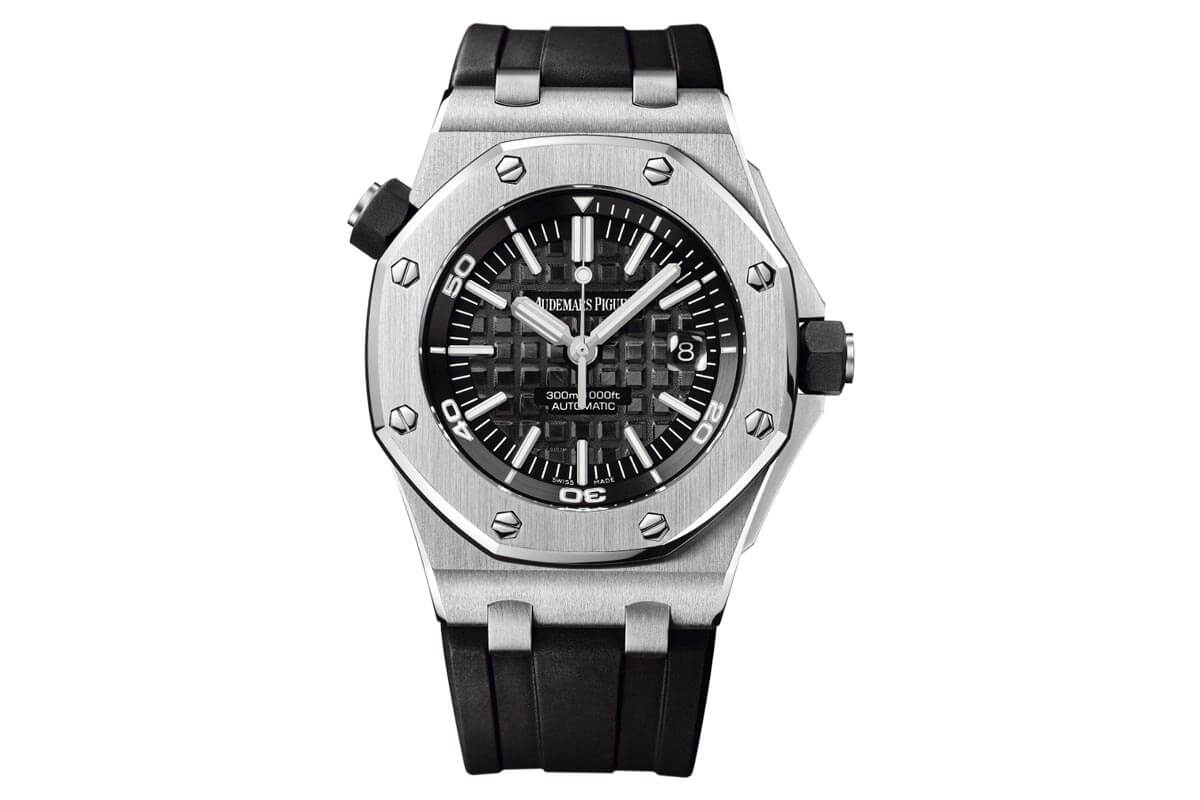
Audemars Piguet Royal Oak Diver 15703st
Our featured watch is the Royal Oak Offshore Diver, reference 15703ST, and it is among the most popular members of the Offshore family. It features the “rubber-clad” accents often found on Offshore models, The case measures 42 mm x 13.9 mm and it offers 300 meter water resistance. The crown at 10 o’clock turns the internal bezel with the typical countdown markings. The Mega Tapisserie dial is a larger version of that found on the Royal Oak shown above, and the broad hands offer excellent legibility. The in-house caliber 3120 provides the power.
The Royal Oak Offshore Diver 15703ST on a rubber strap retails for $19,000

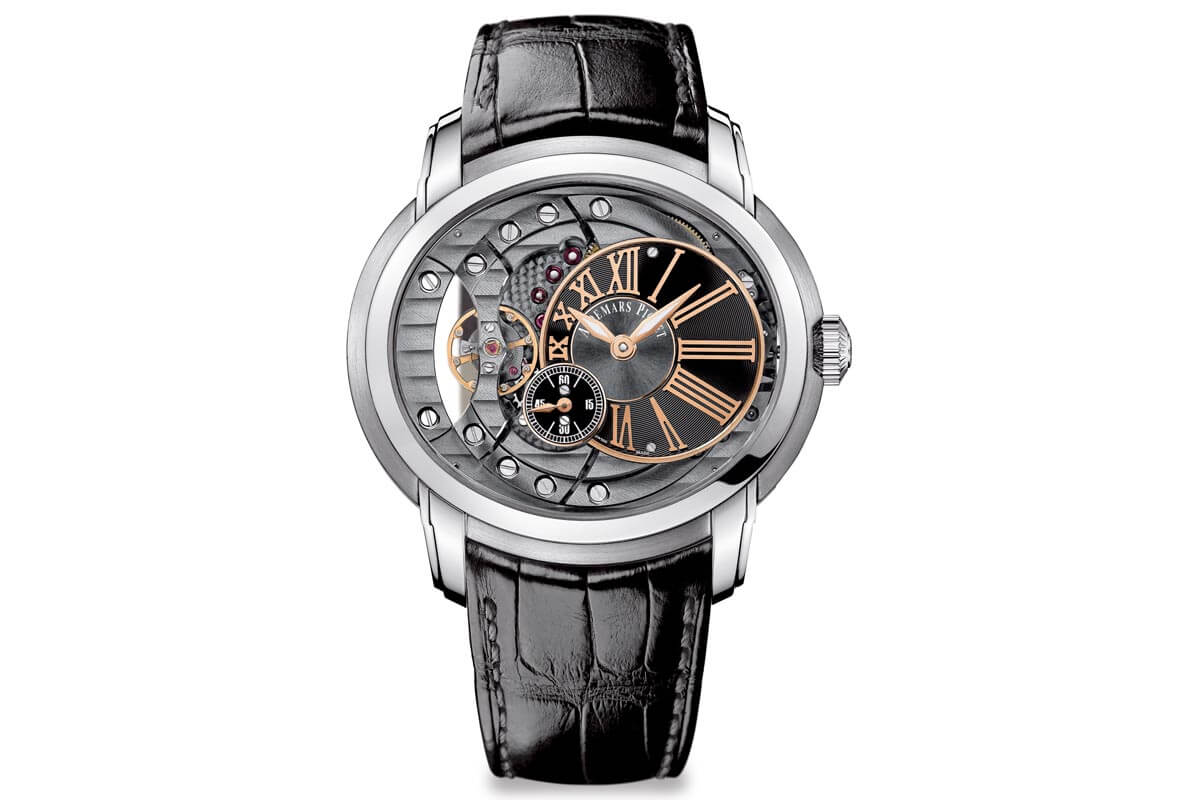
Audemars Piguet Millenary 4101

The Millenary 4101 is Audemars Piguet’s modern spin on the classic dress watch, and like the Royal Oak Offshore, the size and shape of the case instantly set this watch apart. Our featured model, reference 15350ST, measures 47 mm from 9 to 3.
The case may be the first thing that catches the eye, but the movement is the star of the show. Unlike many shaped watches, the Millenary’s in-house caliber 4101 movement fits the case and follows its form perfectly. Though at first glance this may look like a so-called skeleton watch, in fact it is not – no material has been removed from any component to enhance the view. The small dials leave plenty of room to enjoy the traditionally-finished movement beneath, and the sapphire display back offers visual enjoyment from that side as well.
Audemars Piguet Millenary ref.4101

The movement has been designed to create a deep, three-dimensional effect. The construction exposes the freesprung balance at 3 o’clock, and AP has thoughtfully inverted the escapement to improve the view from the dial side. The manufacture caliber 4101 features a solid 22k gold winding rotor spinning on ceramic bearings. Each part of the movement is decorated by hand. These time-consuming operations by highly trained specialists contribute significantly to the cost of the watch. The mainplate wears horizontal Côtes de Genève on the front and perlage, or circular graining, on the back. The bevels and countersinks are polished.
The Millenary 4101 in stainless steel on strap lists for $24,500

Audemars Piguet Royal Oak Offshore Chronograph – 42 mm

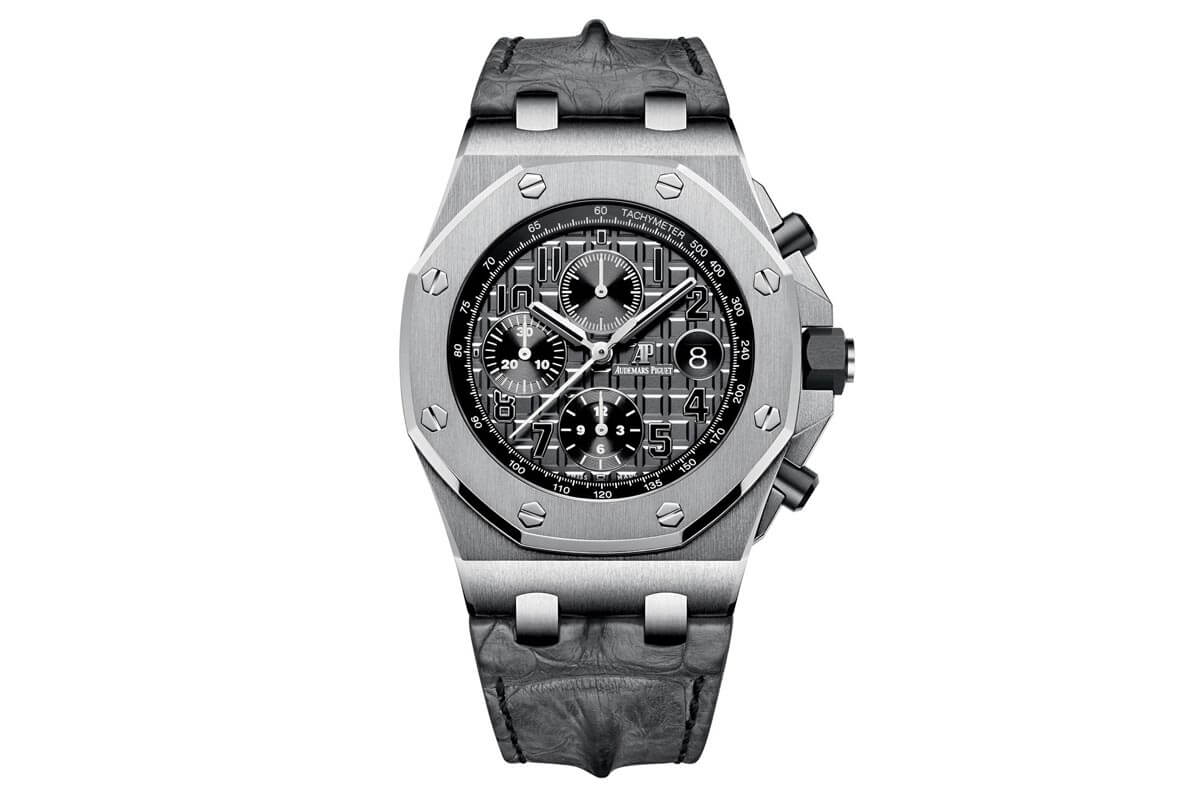
This year Audemars Piguet introduced six new Royal Oak Offshore models, and this is one of the most popular. It’s the ROO Chronograph in a 42 mm x 14.21 mm case with the slate gray “elephant” dial on a gray hand-stitched hornback alligator strap.
Audemars Piguet Royal Oak Offshore 26470
The new collection, which bears reference 26470, incorporates many updates. Rubber accents on the pushers and crown have been upgraded with black ceramic pieces. The new Mega Tapisserie dials have been well received, and the snailed subdials add even more texture. Broader, faceted hour and minute hands improve legibility.
The big surprise is found on the other side of the case: newly added sapphire display backs provide a view of the caliber 3126 chronograph movement with its solid 22k gold winding rotor. This movement features a cam-switching chronograph mechanism and stop-seconds for precise time setting.
The stainless steel Royal Oak Offshore Chronograph retails for $26,000

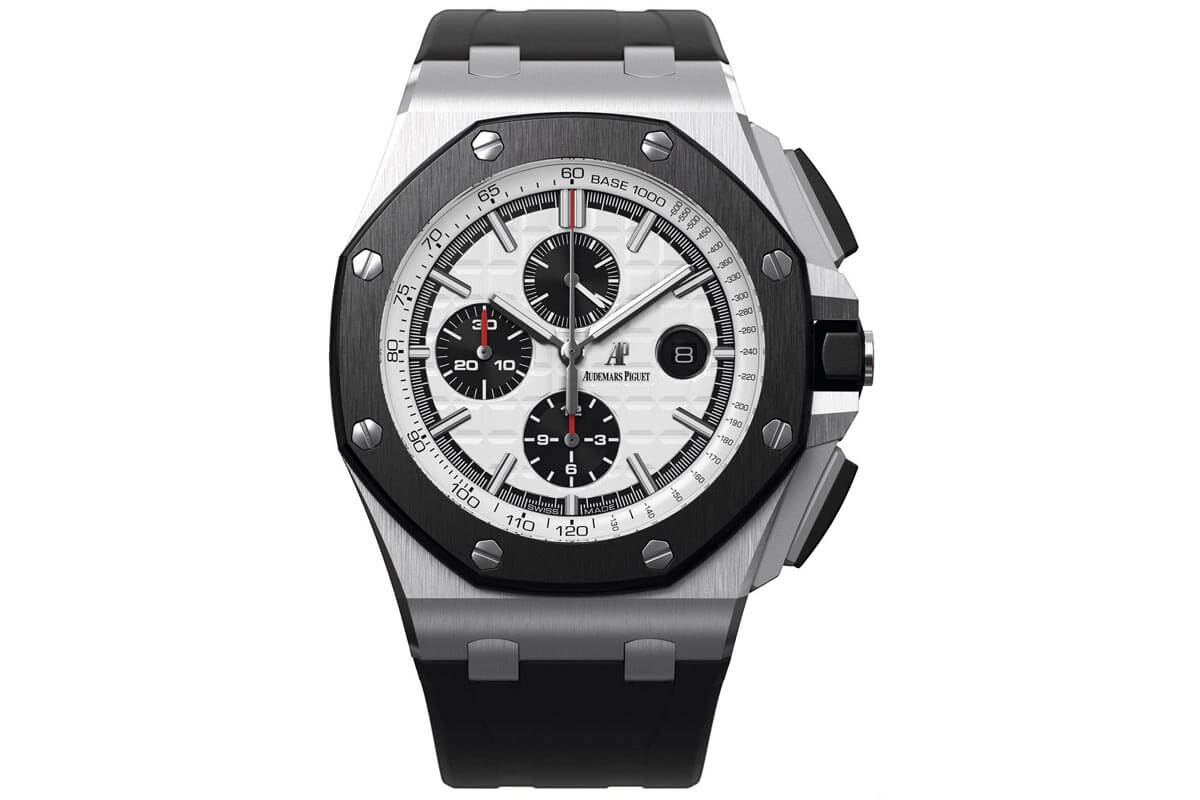
Audemars Piguet Royal Oak Offshore Chronograph – 44 mm

If you seek something a bit bolder than the 42 mm Royal Oak Offshore Chronograph shown above, consider its big brother in a 44 mm x 14.13 mm case. This model retains the familiar black bezel, fashioned from highly scratch-resistant ceramic. Large rectangular pushers replace the smaller round pieces found on the 42 mm models. Like the smaller sibling, this model features the Mega Tapisserie dial, here complimented by white gold hands and hour markers. The broad tachymeter at the outer edge of the dial lets you calculate speed over a known distance.
Audemars Piguet Royal Oak Offshore 26400
Behind the dial lies the caliber 3126 automatic winding chronograph movement with 365 components. The movement runs at 21,600 vph in 59 jewels. The dial registers include continuous seconds at 12 o’clock., a 30-minute counter at 9 o’clock, and a 12-hour counter at 6 o’clock.
The 44mm Royal Oak Offshore Chronograph in steel and ceramic on rubber strap, reference 26400, lists at $33,400
This article was first thankful by WatchTime, updated and republished on Monochrome-Watches with authorization. its  noted likewise and  thankful for  such a aqquired article also

Wednesday, 16 December 2015

The Rolex Watch Guide for beginners

                            Rolex  for beginners for  all

                                                   
Rolex has long been known as a horological status symbol. From the small business owner to the billionaire hip hop mogul, Rolex is arguably the largest and most prominent luxury watch company in the world.
From the basic stainless steel models under $10,000 to the binged out diamond bezels that fetch over $50,000, the fact is that Rolex has managed to acquire and maintain one of the most diverse client bases the world has ever seen. It consistently ranks high on lists of the top global brands and is influential the world over.
 

The History of Rolex

When two men married into the same family decided to start the company, it was originally named Wilsorf and Davis after the founders Hans Wilsorf and his brother-in-law Alfred Davis.
Initially intended to just be an importer of Aeigler’s Swiss watch movements to England, the company which would eventually become Rolex SA, was registered in London, England in 1905.
Wilsorf and Davis began to import the Swiss movements and place them in watches made by Dennison and others that they proceeded to sell to jewellers who put the name W&D on the inside of the case back and allowed the independent jewellers to place their own names on the dials.
It wasn’t until 1908 that Wilsorf registered the trademark “Rolex” and opened an office in La Chaux-de-Fonds, Switzerland. The name Rolex is often discussed, but widely believed by horologists to be a made up name that was used because it was onomatopoeic and easily pronounced in any language or accent. It reminded Wilsorf of the winding sounds of the watch and it is believed that these reasons are why the name Rolex was chosen to eventually become the name of their brand. It also helped of course, that the name was short enough to fit on the face of a watch and symmetrical.
By 1914, Wilsorf and Davis’ watches were so well established and known that the Kew Observatory awarded Rolex with a Class A precision certificate that was normally only awarded to marine chronometers. In 1919, Wilsorf left England due to the wartime taxation levied against luxury imports in addition to the exportation duties on silver and gold. With costs increasing, he moved the company to Geneva, Switzerland where he renamed it the Rolex Watch Company. Over the next few decades it would be changed again to Monres Rolex, SA and finally to Rolex, SA as it’s known today.
Wilsdorf quickly became well known as a charitable man and positioned himself as quite the contributor when he began replacing the Rolex watches of Britain’s soldiers who were captured as prisoners of war during World War II. When the POWs were captured and sent to camps the Rolex watches they had began purchasing were seized and confiscated by the Nazis. Many pilots had began to wear Rolex watches by the beginning of the 1940s as the quality superseded that of the generic watches they were issued by the military. In fact, one of the most well documented uses of a Rolex was when the watch was used to time the highly publicized Great Escape.
It was that one, of the 3000+ watches awarded to Royal Air Force pilots that was sent when a letter was received by Hans Wilsorf, written by a POW named Corporal Clive James Nutting.
Nutting had written to Rolex the same as many other servicemen, knowing that his precious watch would be replaced free of charge until the war was over. The watch, a stainless steel Rolex Oyster 3525 Chronograph was mailed to Nutting directly from Wilsorf and delivered to Stalag Looft II on July 10, 1943 with a note informing Nutting he “should not even think” about paying for the timepiece before the end of the war. What Wilsorf didn’t know at the time was the watch was specifically ordered for the purpose of orchestrating the Great Escape.
Far more expensive than the usual Speed King model ordered by airmen, Nutting used the chronograph to time the patrols of the prison guards as well as the 76 escapees through the tunnel on March 24, 1944. Eventually, after the war, Nutting did receive a bill for the watch for a grand total of just £15. In May, 2007, the watch was sold at auction for £66,000. Then, in November 2013, the Rolex Speed King owned by Flight Lieutenant Gerald Imeson during the Great Escape sold at auction for £60,000.
In 1944, one year before the war ended, Wilsorf wife tragically died. Wilsorf was very concerned that due to the massive growth of his company and with the United States showing interest due to his charity towards the captured servicemen, that his hard-earned money would simply go into the pockets of already wealthy investors should the company ever go public. To prevent such a thing from occurring, he established the Hans Wilsorf Foundation and left all of his shares to the charity to ensure that at least a portion the company’s income would go to charitable initiatives. To this very day Rolex is privately owned and it’s ownership lays in trust with the Hans Wilsorf Foundation. Despite its size, Rolex does not trade publicly on any stock market.
Today, Rolex is one of the world’s most powerful companies and the largest luxury watch brand in the world. They produce an average of 2,000 watches each day and maintain record revenues of upwards of $7 billion each year.
 
I hope you enjoyed this as much as I did thumbs up to all

Friday, 11 December 2015

selling a rolex

                          How to sell a  Rolex watch


If you our wondering how to sell a Rolex watch for the highest possible cash offer, Diamond Estate Jewelry Buyers can help. We are widely recognized as one of the best places in the country to sell vintage and limited-edition Rolex watches.
Thanks to our exclusive network of private Rolex buyers and collectors, we are able to regularly pay our clients not only more cash than any other watch buyer, but also more than they would have obtained by selling their Rolex through an online watch auction.
Because Rolex watches are made with such precision and with superior high-grade materials, they can yield their owners a substantial cash offer from luxury watch buyers. You can rely on Diamond Estate to freely share with you all of our expert knowledge, so that you can make the best educated decision about how to sell your Rolex watch.
In this article, our Rolex buyers will cover some common questions that clients have when planning to sell a used Rolex watch to Diamond Estate Jewelry Buyers.
1) Can I sell my Rolex watch for a good price if it contains non-Rolex parts?
Rolex buyers place a much higher value on a Rolex watch that has all of its original Rolex parts. It’s important that all Rolex owners ensure that authentic Rolex replacement parts are used when having their Rolex watch serviced, because non-Rolex parts will significantly lower the timepiece’s value. That being said, depending on what has been replaced, you may be able to get a good price when selling your used Rolex.
The best thing to do is to take advantage of Diamond Estate Jewelry Buyer’s free verbal Rolex appraisal to discover how much your timepiece is worth to our Rolex buyers.
2) Does supporting sales material increase the offer when selling a used Rolex watch?
California Rolex Buyers Absolutely. As you may know, there is probably no timepiece more often copied than a Rolex. There a literally hundreds of thousands of counterfeit Rolex watches in circulation. This can make it more difficult to sell a used Rolex watch without the original box and papers.
While a professional Rolex buyer can authenticate your Rolex watch without such items, they may find it more difficult to resell your watch to another customer. So, to get the best possible price when selling your Rolex, do include all and any original sales materials than came with your purchase.
3) Should I refurbish the dial before selling my used Rolex watch?
The answer is no. You probably have seen TV shows where a person selling a valuable vintage or antique item is told they never should have refurbished their item because collectors prefer the original untouched finish, regardless of its state. The same goes for Rolex watches. Even if the dial on your used Rolex does not look like new, you do not want to have it refurbished.
4) Does the state of the band affect the price when selling a Rolex?
Yes it does. Selling a used Rolex with a tight (like new) original band will bring you a higher cash offer than if the band is loose and older looking.
5) Can I sell a used Rolex watch even if it is not working?
Yes, you can. This may be surprising but you can often sell a Rolex watch that is not working for a price that is not far below the price of a used Rolex in working condition. The reason for this is that professional Rolex buyers can ordinarily have a Rolex that is not working repaired for a reasonable price.
6) Will I get close to the retail price when selling my Rolex?
Auction a Rolex While Rolex watches do hold their value well, you should not expect to receive a cash offer close to the retail price. You need to keep in mind that the jeweler who sold you your Rolex needs to make a substantial profit to stay in business. Just as when a car driven off a lot immediately depreciates in value some 20-30%, so does a new Rolex watch immediately depreciate in value once it has been bought (the exact percentage of depreciation will vary).
In addition, the Rolex buyer who purchases your used Rolex needs to make a profit too, so that that he or she can stay in business. Therefore, while you can expect a substantial cash offer for a used Rolex,  the amount will ordinarily not be close to the retail price–the exception being for certain vintage, limited-edition, and antique Rolex models which are hard to find and in high demand.
7) How safe is it to sell my Rolex watch online?
Selling a Rolex online to Diamond Estate Jewelry Buyers is highly secure and involves no risk whatsoever. We provide you with free FedEx Overnight shipping and your Rolex watch will be insured to its maximum value by G4S International Logistics, the world’s largest security services provider.
If you decline our final cash offer for any reason, we will be happy to ship your Rolex back to you at our expense. For more information about selling a used Rolex watch online to our Rolex buyers, please click on the following link: Sell My Rolex From Home.
If you decide that you would like to try to sell your Rolex online at eBay, there are a few things you can do to protect yourself: a) Sell your Rolex watch only to a buyer who lives in the United States. b) Take a photo of your Rolex that shows the serial number to help prevent return fraud. c) Don’t use a PayPal account that is linked to a bank account with a large balance.
8) How can I tell if my used Rolex watch is fake?
Used Rolex Buyers It’s always upsetting to discover that you’ve unwittingly purchased a fake Rolex watch. But due to the prevalence of fake Rolex watches, it is an unhappy situation that can and does happen. Here are some times when you don’t want to try to sell your Rolex watch because it unfortunately is a fake one:
  • Don’t try to sell a used Rolex if there is rubber to be found anywhere on the band or case. It’s fake.
  • Don’t try to sell a Rolex watch if it has a skeleton dial (a dial that displays the moving parts of the watch). It’s fake.
  • Don’t try to sell your Rolex if it says that it was made in China. It’s fake.
  • Don’t try to sell a used Rolex watch if it has a see-through glass case back. It’s fake.
  • Don’t try to sell a Rolex Oyster Perpetual if it does NOT have a screwed-back case. It’s fake.

Thursday, 10 December 2015

watch guide for beginners continued


                      general watch guide for  beginners


There comes a time in every gentleman’s life when he starts to value time — he values it so much, in fact, that he wants to wear it as a gorgeous piece on his wrist. At this point, it is time to start a watch collection.
This should be done carefully. A gentleman should conduct his research before selecting his first watch. It is a deduction that requires an understanding of not only what is out there, but also of one’s own personal style.
And of course, one’s own financial limitations.
“Unless you’re spending $US5,000 to $US10,000 you’re not going to have an investment-grade watch,” says Benjamin Clymer, editor of men’s watch site, Hodinkee. “Just make sure you buy something that you love … Really do your homework. … There’s nothing worse than realising you don’t have the watch that you think you have.”
Now here’s what you can have. You must decide if you would like your watch to be automatic or manual (meaning you’ll have to wind it). You must decide if you would like to purchase a vintage watch (from, say, eBay or a flea market) or a new watch.
After that, there are still almost too many options, so here are some things to keep in mind.
“Like so many other things in men’s dress, it is best to keep your watch pretty simple and restrained,” says Justin Jeffers of men’s style blog, The Fine Young Gentleman. “Not restrained in the sense that you shouldn’t wear a $US25,000 watch … But restrained in the sense that a man shouldn’t wear some oversized, over iced or over styled watch (or anything else) on his wrist. … A watch should not be so big that your shirt cuff cannot fit over it. There are few things more gaudy than a huge watch face staring you in the face from someone else’s wrist. It takes attention away from the things that matter (like the wearer’s face) and puts it where it doesn’t matter (the wearer’s wrist).”
Now let’s say you’re starting out at a fairly low price point (under $US500). What should you get?
Consider going vintage; it’s more work but it’s also more rewarding. Clymer recommends purchasing an old Omega brand.
You’ll want to make sure the vintage piece you buy has as much of its old parts intact as possible, especially with things you can see, like the dial or the face. You want your watch to look old — like it’s been passed down from generation to generation.
“The dream watch for a vintage watch collector is a watch that has never been serviced or messed with at all,” says Clymer.
If you want a new watch, things are a little different.
“To get a really mechanical watch [under $US500] you’re going to want to look at Seiko,” said Clymer.
Bulova Men's Dress watch
You could also check out Pulsar, Timex, Citizen, Daniel Wellington, Bulova, Shinola, ESQ, Luminox, and Tissot. There’s a debate raging in the men’s watch world about whether or not you should buy from a company that creates items other than watches (like, say, a Burberry) — but it’s bloody, and Business Insider is staying out of it.
What’s more important is that you take care of your watch.
“Keep your watch away from super magnets (large speakers, buckyballs, etc). Although unlikely, it could move pieces inside,” says Kirk Miller, nation editor at men’s lifestyle newsletter, InsideHook. “Extreme temperature changes, shouldn’t be a problem, but again be careful. Expansion and contraction do funny things to watch insides. Leave your watch in the locker when going into the sauna.”
And take care of how you use your watch, as well.
“Do not wear a sports or digital watch with a suit. It’s like putting VW wheels on an Audi,” says Jeffers.
All this said, you’re going to have to service your watch. Especially if you buy something high end or vintage. If your watch is new, you can take it to the manufacturer. If it’s vintage, make sure to go to someone who understands what you want, and won’t Frankenstein your watch with new parts you don’t want.
If you do all that, your watch could last forever.


thankyou for your endeverous reading upon my blog and I will see you tomorrow stay tuned...